
What you can wire yourself in Calgary, and what needs a contractor
Read this one carefully and then check it yourself. Permit rules are set by the authority having jurisdiction and they differ between municipalities. What is on this page is what applied in Calgary when we last checked it, on the date at the bottom. Before you plan a build around any of it, confirm it with your own AHJ. We will tell you what we know and where the edges of what we know are.
The part that surprises people
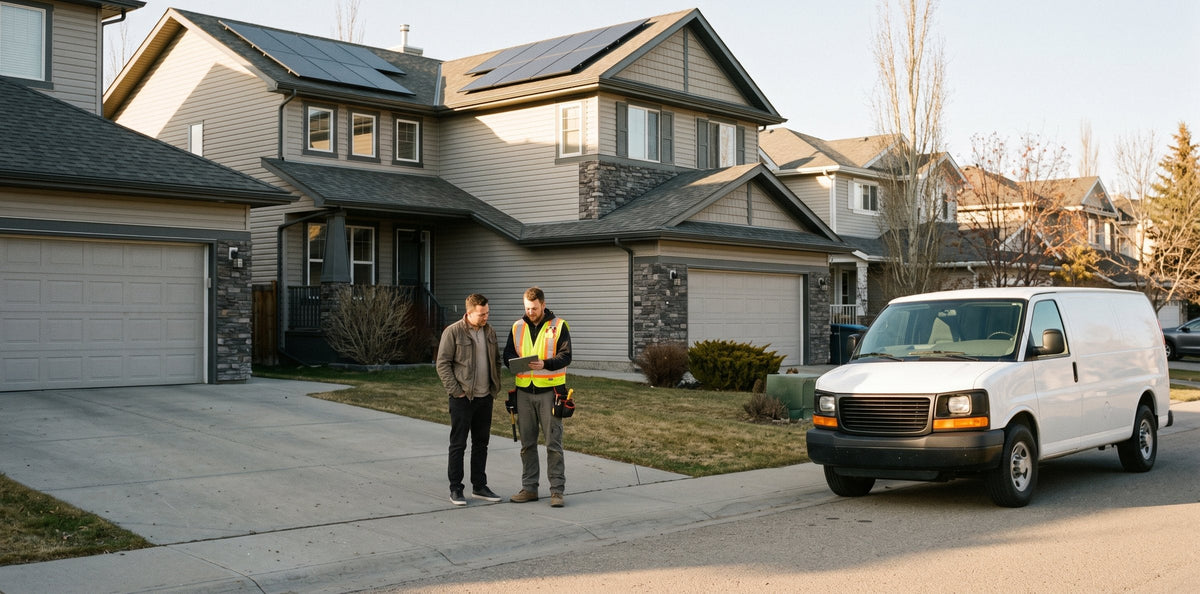
In Calgary, a homeowner cannot self-install a grid-tied photovoltaic array or a battery energy storage system. Both require an electrical permit, and the permit requires a licensed, registered electrical contractor. Homeowner installation is not permitted for this work.
That is a real constraint and it changes what a DIY grid-tied project in Calgary actually is. It does not stop you building one. It means the final electrical work, the permit and the inspection go through a contractor, and the parts of the job before that are yours.
It also means anyone telling you otherwise is selling you something. A kit marketed as a homeowner-installable grid-tie, bought into Calgary, is a kit you cannot legally finish.
So what is still yours
More than people assume, and the expensive half of it.
The design. Array layout, string configuration, orientation, shading, how the system is sized against your actual consumption. Nobody takes that away from you and it is where the quality of the result is decided.
The specification. Which panels, which inverter, which battery, which racking, which wire gauge, what protection. Your contractor is installing to the design in front of him. If you have specified it properly, that is your design.
The procurement. You buy the gear. A contractor who supplies the parts is marking them up, and on a $15,000–$35,000 hardware bill that is not a small number. Supplying your own hardware is the most common way a Calgary owner takes real money out of a grid-tied project, and it is entirely legal.
All the non-electrical work, which is most of the labour. Racking, mounting, flashing, penetrations, conduit runs, cable routing, ground mount foundations.
The paperwork you actually care about. Micro-generation application, utility interconnection, sizing against the annual-consumption allowance.
Who does what on a grid-tied build in Calgary
| Job | Who does it |
|---|---|
| Design: layout, strings, orientation, sizing | You |
| Specification: panels, inverter, battery, racking, wire, protection | You |
| Buying the hardware | You |
| Racking, mounting, flashing, penetrations, ground-mount foundations | You |
| Micro-generation application and utility interconnection | You |
| Electrical permit | Licensed electrical contractor |
| Final electrical work and connection | Licensed electrical contractor |
| Inspection | Licensed electrical contractor |
Off-grid, an acreage that never touches the grid, or a 12 V system in a van: confirm with your own AHJ where the line sits for your build.
Where the rules are different, and where we stop
Off-grid is not the same question as grid-tied. A standalone system on an acreage that never touches the utility sits in a different place than a grid-interconnected array on a house in the city, and so does a 12 V system in a van, which is not building wiring at all.
We are not going to tell you where the line is for your build. It depends on your municipality, your AHJ, whether the structure is a dwelling, and whether anything connects to the grid. That is one phone call to your AHJ and it is worth making before you buy anything, because it is the difference between a system you can finish and one you cannot.
What we will say is that the rest of this page applies either way. Whoever does the final connection, the code the work has to satisfy is the same one, and the parts either pass or they do not.
The three things that fail inspections, and they are all purchasing decisions
Certification. Alberta accepts equipment approved by a body accredited by the Standards Council of Canada. The mark has to be on the equipment. And the exact string matters more than people think — a UL 9540A test report is not a UL 9540 listing. 9540A is a test method that produces data on fire propagation; it does not by itself yield a listing. A battery system sold to you on a 9540A report, where the inspector wants a 9540 listing, is a stranded asset in your garage.
Ask for the exact certification string before you buy.
String voltage in the cold. This is the one that costs an inverter. Open-circuit voltage rises as temperature falls, and a string sized on the panel's room-temperature Voc will exceed the inverter's maximum PV input on a cold clear January morning — the exact conditions that also produce the year's best light. The Canadian Electrical Code sets out how to size for it, and permits two different methods. Size for it before you buy the inverter, because this is the single most expensive thing a self-specifier gets wrong.
Overcurrent protection and conductor sizing. Fuse and breaker class, current rating, DC voltage rating stated separately from AC, and the interrupt rating checked against what the bank can actually deliver — not the inverter's badge. Then the conductor sized to its own ampacity with the right derating for temperature and bundling.
What we would do in your position
Decide the design and the spec yourself. Buy the hardware yourself. Hire the licensed work.
That is not a compromise version of DIY. On a grid-tied Calgary build it is the version that exists, and it keeps the two things that were always the point — control over what goes on your roof, and the margin that would otherwise sit in somebody else's supply line.
Bring your parts list to the counter before you order it. We'll go through it with you, and anything we can't answer goes to the licensed electricians on Solar YYC's install crews.
Bring your list to the counter Browse fuses and breakers
Checked against the sources named below on 12 September 2026. Permit rules are set by your authority having jurisdiction and change. Confirm with your own AHJ before you plan a build around anything here.
Sources: City of Calgary electrical permit requirements for photovoltaic and battery energy storage systems. Canadian Electrical Code. UL 9540 and UL 9540A. Standards Council of Canada accreditation and Alberta's approval position.
Parts for this guide
See all Combiners, Breakers and Fuses


Got a question about your build?
Bring the model number, a photo of the label or your parts list to the counter, or send it to us. The hard ones go to the licensed electricians on Solar YYC's crews, who've done 2,000+ projects in Alberta.
Ask us something


