A lithium battery that won't charge: protection mode, sleep, and when it's done
A lithium battery that won't take a charge has usually switched itself off on purpose. Its battery management system (BMS) stops the charge when the cells are too cold, run too low or pushed too hard, and lets it through again once that condition clears. Finding out which one it saw is most of the job.
How do I revive a lithium battery that won't charge?
Start by finding out why the BMS stopped it. On the batteries in our catalogue, the BMS stops a charge when the cells are below the charge temperature limit, when the pack is full, when it has run down far enough to switch itself off, or when it sees a fault such as too much current. A pack can also read as full when only some of its cells are full. It then needs its cells balanced, which a slow, low charge can sometimes do. In winter, start with the temperature. Here are the batteries in our catalogue:
| Battery | Takes a charge from | Built-in heat |
|---|---|---|
| Pytes V5, 51.2 V, 5.12 kWh | 0 °C | Heating pad that works from −20 to 10 °C |
| Pytes V5α Plus, 51.2 V, 5.12 kWh | −10 °C | 250 W heating film, on at 5 °C or below and off at 15 °C or above, powered by the charging source |
| Soluna 10K and 16K LV packs, 51.2 V | Not stated separately (one operating range, −10 to 50 °C) | None on these models |
A battery below its charge figure is waiting for heat, and the charge starts once it warms past it. The V5α Plus film runs on power from the panels, the grid or a generator, and it doesn't take power from the battery itself. On a dark morning it waits until one of them is on.
The charge controller usually says what's happening. A Victron SmartSolar shows it in the VictronConnect app under "Why is the charger off?", where "Low lithium battery temperature" and "The charger is disabled by remote or BMS" are two of the answers. Charging picks up again by itself once the battery warms. The SmartSolar also waits for the panels: it starts charging only when the panel voltage is 5 V above the battery's, which on a grey winter morning can take a while.
How do I get a lithium battery out of protection mode?
Clear the cause and the battery comes back by itself. A Pytes V5 or V5α Plus returns to normal operation on its own once the condition that tripped it is gone. Its red ALM light tells you where it stands: flashing means an alarm, and steady means the battery has protected itself.
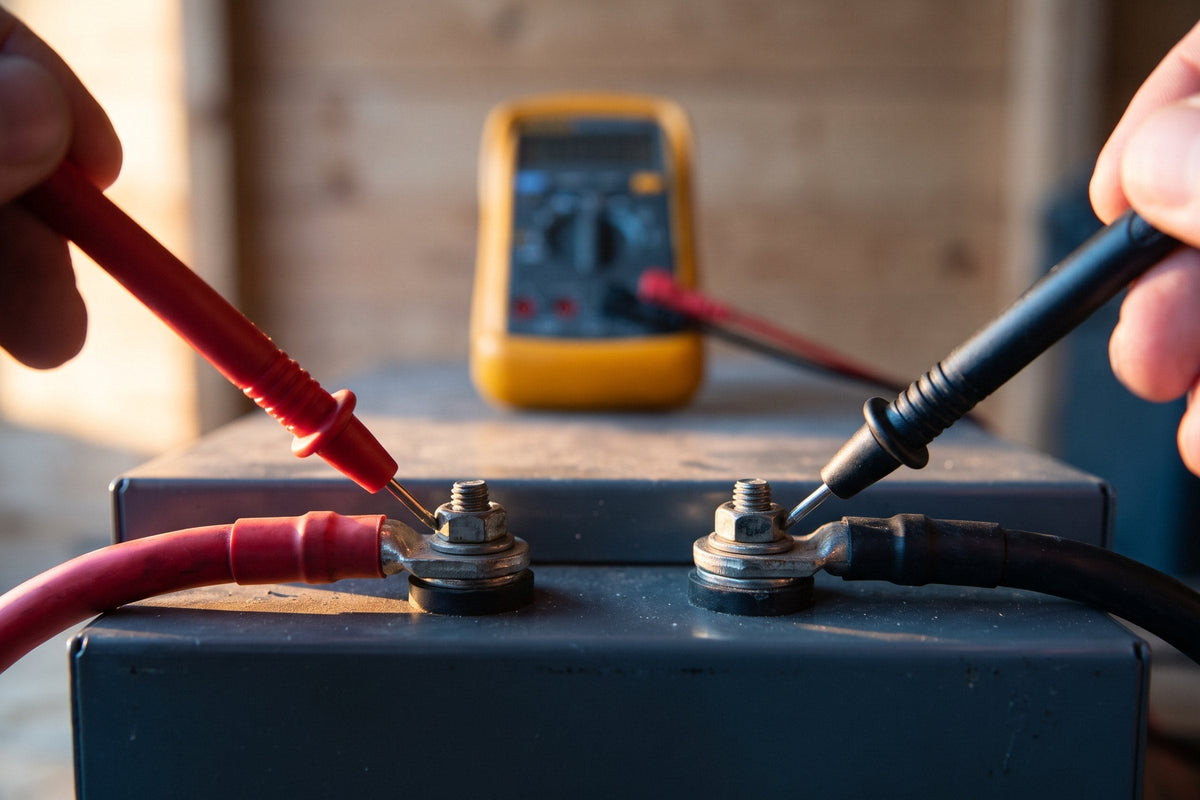
If a Pytes won't charge and the red light is steady, unplug the battery's power cable, find what caused the protection and fix it, then restart the battery. Four readings point to the cause: the charging voltage, the charge and discharge current, the battery and cell voltage, and the temperature.
How do I wake up a lithium battery from sleep mode?
On a Pytes, press the start button or give it charging power. The V5 and V5α Plus each have a power switch and a soft-start button marked SW. With the power switch on, hold SW for one second to start the battery. In a bank, press SW on the master battery only and wait about three seconds while each battery's running light flashes in turn. Holding SW for one second also puts a running battery to sleep, and holding SW on the master for three seconds shuts the bank down.
A Pytes that has only gone to sleep comes back by itself when a charger puts power on it. One that has gone into deep sleep needs SW pressed first.
A Soluna 10K Pack LV starts with its metal button switch, which is the factory setting, or with its switch if it has been set up the other way. It starts within 25 seconds, and if it doesn't establish communication within 5 minutes, it stops putting out power. So if a Soluna starts and then stops putting out power a few minutes later, check its communication cable and settings first. For anything else, go by its user manual, and bring the manual or the model number to the counter if the pack doesn't do what the manual describes.
Can a dead lithium battery be brought back to life?
It can be, if the BMS shut it off in time and it gets a charge soon after. Pytes asks for a fully discharged V5 or V5α Plus, or one in over-discharge protection, to be charged within 12 hours. A battery that has switched itself off still loses a little charge every month, and the longer it sits empty, the lower its cells go.
That's why the clock matters. Battery University's advice for lithium-based cells is to never boost a cell back to life after it has sat below 1.5 V per cell for a week or longer, because copper shunts can form inside it, and a cell with a partial short can become unstable when it's recharged.
If a Pytes has no power left at all when you check it, Pytes's instruction is to stop: don't charge it or use it, and contact your installer. If you're the installer, that means the seller or Pytes.
How do I force a lithium battery to charge, or trick a dead one into charging?
On these batteries, you don't. The ways in are the start button and power from a charger. When neither wakes the battery, don't charge it or use it until the seller or the maker has told you how.
What are the odds of a lithium battery exploding?
That depends a great deal on the chemistry. Every lithium battery in our catalogue is lithium iron phosphate (LiFePO4). Battery University puts its thermal runaway point at about 270 °C, against about 210 °C for NMC cells and 150 °C for lithium cobalt oxide, and calls it one of the safest lithium-ion chemistries. On top of that, the BMS guards against charging too high, too cold and too fast, which is what makes these batteries refuse a charge in the first place.
How do I keep it from happening again?
Let the inverter stop before the BMS has to. Pytes's setup guide gives the inverter two levels for the battery: a low-battery level where the inverter alarms, and a shutdown level where it shuts down. Set them so the inverter stops while the battery still has charge in it, and the BMS never has to cut the pack off. If your inverter has a generator-start setting, set it to start the generator before the battery gets that low.
For a Pytes in a cabin you close up for the winter, keep it between 40% and 60% in storage, and before a gap longer than six months, charge it above 90%. Pytes's manual then asks for a top-up above 90% every six months, done by a maintenance technician Pytes has approved. Where the battery lives in the cold is covered in Charging and storing lithium batteries in an Alberta winter.
Not sure why yours stopped? Bring the battery model, what its lights are doing and what the inverter or controller shows to the counter, or call 587-287-9180.
On this page: Pytes V5 · Pytes V5α Plus · Soluna 10K and 16K LV · Victron SmartSolar MPPT. Batteries · MPPT charge controllers · Wiring a 48 V battery bank.
Battery figures are from each maker's datasheet and user manual, linked on each product page. Charge controller behaviour: Victron's SmartSolar MPPT manual. Cell safety: Battery University, BU-808a and BU-205.
Parts for this guide
See all Batteries


Got a question about your build?
Bring the model number, a photo of the label or your parts list to the counter, or send it to us. The hard ones go to the licensed electricians on Solar YYC's crews, who've done 2,000+ projects in Alberta.
Ask us something